
Inventory of Hazardous Materials (IHM): What Every Shipowner Needs to Know
Many shipowners view the Inventory of Hazardous Materials (IHM) as a requirement for surveys or ship recycling. However, it is a critical tool for IHM compliance and maritime environmental compliance, supporting safe vessel operations throughout a ship’s lifecycle. An accurate and well-maintained IHM helps protect workers, minimize environmental risks, facilitate responsible ship recycling, and reduce the likelihood of costly delays, penalties, and legal liabilities.
Whether you manage a single vessel or an international fleet, understanding the IHM is essential for complying with the Hong Kong International Convention (HKC), the European Ship Recycling Regulation (EUSSR), and the broader requirements of the International Maritime Organization (IMO).
In this three-part series of articles, we provide a practical overview of the Inventory of Hazardous Materials, including why it is required, how it is prepared and maintained, common compliance pitfalls to avoid, and best practices to ensure your vessel remains compliant throughout its operational life.
Understanding the Inventory of Hazardous Materials (IHM)
What is an IHM?
An IHM is a comprehensive document that identifies the hazardous materials present on board a vessel, records their approximate quantities, and pinpoints their locations. More than a simple checklist, the IHM serves as a living record that follows a ship throughout its operational life, supporting safe maintenance, regulatory compliance, and environmentally responsible recycling.
The IHM was developed by the International Maritime Organization (IMO) as part of the Hong Kong International Convention for the Safe and Environmentally Sound Recycling of Ships (HKC). It has also become a key requirement under the European Ship Recycling Regulation (EUSSR) for vessels operating within the European Union.
Key TakeawayAn IHM is not simply a document for ship recycling. It is a lifecycle management tool that supports safety, regulatory compliance, and responsible environmental management from commissioning through to end-of-life recycling. |
Unlike many compliance documents that are prepared once and archived, the IHM must be continuously maintained and updated whenever new equipment, materials, or modifications are introduced onboard. This ensures that it accurately reflects the vessel’s current condition and remains reliable for inspections, repairs, conversions, and, ultimately, recycling.
An IHM typically lists hazardous materials such as asbestos, polychlorinated biphenyls (PCBs), ozone-depleting substances, heavy metals, radioactive materials, and other substances that require special handling due to their potential risks to human health or the environment. For each identified material, the inventory records its location, estimated quantity, and supporting evidence, providing a clear reference for surveyors, shipyards, and recycling facilities.
Why Is an IHM Important?
An accurate and up-to-date IHM delivers benefits that extend well beyond regulatory compliance. It helps shipowners, operators, shipyards, and recycling facilities improve safety, reduce environmental impacts, and manage operational risks throughout a vessel’s lifecycle.
Protects Worker Health and Safety
Maintenance, repairs, and recycling frequently involve cutting, welding, and dismantling activities that may disturb hazardous materials. An accurate IHM enables shipyards and contractors to identify these hazards in advance, implement appropriate control measures, and ensure workers use suitable personal protective equipment (PPE).
Reduces Environmental Impact
Hazardous substances onboard can contaminate soil, water, and marine ecosystems if improperly handled. By identifying where these materials are located, the IHM supports their safe removal, handling, and disposal in accordance with environmental regulations.
Supports Safe and Responsible Ship Recycling
The IHM provides recycling facilities with the information needed to safely dismantle vessels, manage hazardous waste, and recover recyclable materials. A complete inventory also helps minimize delays, reduce project costs, and improve workers’ safety during recycling.
Ensures Regulatory Compliance
Maintaining an accurate IHM demonstrates compliance with the Hong Kong International Convention (HKC), the European Ship Recycling Regulation (EUSSR),
and other applicable maritime requirements. It also helps avoid inspection delays, corrective actions, and potential regulatory penalties.
Improves Lifecycle Transparency
As vessels undergo repairs, retrofits, and equipment replacements, the IHM provides a continuously updated record of hazardous materials. This supports better planning, smoother surveys, and greater continuity between shipowners, technical managers, shipyards, and recycling facilities.
Why was the IHM introduced?
For much of the twentieth century, there were few internationally recognized standards governing how ships should be dismantled at the end of their operational lives. As a result, many aging vessels were sold to recycling yards, where they were dismantled under limited oversight, with inadequate worker protection and minimal environmental safeguards.
As increasing numbers of ships reached the end of their service lives during the 1990s and early 2000s, concerns grew over unsafe recycling practices and their impact on workers and the environment. One of the fundamental challenges was that shipowners and recycling facilities often had little or no reliable information about the hazardous materials contained within a vessel. Without an accurate inventory, workers could unknowingly cut into asbestos insulation, dismantle PCB-containing electrical equipment, or release toxic substances during demolition.
Recognizing these risks, the IMO developed the HKC. Adopted in 2009 and entered into force in 2025, the Convention introduced a comprehensive framework for improving ship recycling safety and environmental performance. At the heart of this framework is the IHM, which ensures hazardous substances are identified, documented, and managed throughout a vessel’s lifecycle.
Why the IHM became necessary
Unsafe Ship Recycling Practices
Historically, many ships were dismantled using labor-intensive methods with little planning or hazard identification. Workers often relied on manual cutting equipment, cranes, and basic tools to dismantle vessels without knowing where hazardous substances were located, which could cause them to be released unexpectedly during dismantling.
Worker Fatalities and Occupational Illnesses
Ship recycling is inherently hazardous, involving heavy lifting, cutting operations, confined spaces, and work at height. These risks are significantly increased when hazardous materials are not properly identified, exposing workers to asbestos fibers released during insulation removal, toxic fumes generated during hot work, explosions caused by residual fuel vapors, falls from unstable structures, and fires resulting from improper preparation of tanks and enclosed spaces.
Beyond immediate workplace accidents, long-term exposure to hazardous substances has been linked to serious occupational diseases, including lung cancer, mesothelioma, asbestosis, neurological disorders, and chronic respiratory illnesses.
Environmental Contamination
Ships contain a wide range of materials that can pose significant environmental risks if improperly handled or disposed of. Without adequate controls, hazardous substances may contaminate coastal waters, marine ecosystems, soil, groundwater, and air through dust and toxic emissions. Examples include oil residues, heavy metal pollution, PCB-containing equipment, ozone-depleting substances, and contaminated insulation materials.
Beaching Ship Recycling Practices
One of the most widely discussed issues in ship recycling has been the practice of beaching, where vessels are deliberately run aground on tidal beaches for dismantling. While beaching has enabled large numbers of vessels to be recycled economically and supported local employment, concerns have been raised about the environmental and occupational challenges, particularly where infrastructure, containment systems, and worker protections have been inadequate.
Regardless of the recycling method used, an accurate and up-to-date IHM provides a systematic record of hazardous materials, enabling recycling facilities to plan appropriate containment, handling, and disposal procedures and to reduce risks to workers and the environment.
From Reactive Safety to Proactive Risk Management
Before the introduction of the IHM, hazardous materials were often discovered only after work had begun, increasing the likelihood of accidents, delays, and environmental releases.
The IMO fundamentally changed this approach by requiring hazardous materials to be identified, documented, and managed throughout a vessel’s operational life, not just when it reaches the recycling yard.
Today, the IHM is recognized as one of the cornerstones of modern maritime environmental compliance, supporting safer maintenance, responsible ship recycling, and improved lifecycle management.
Not every vessel is subject to the same IHM requirements. Applicability depends on factors such as vessel type, gross tonnage, flag, and the regulations under which the vessel operates.
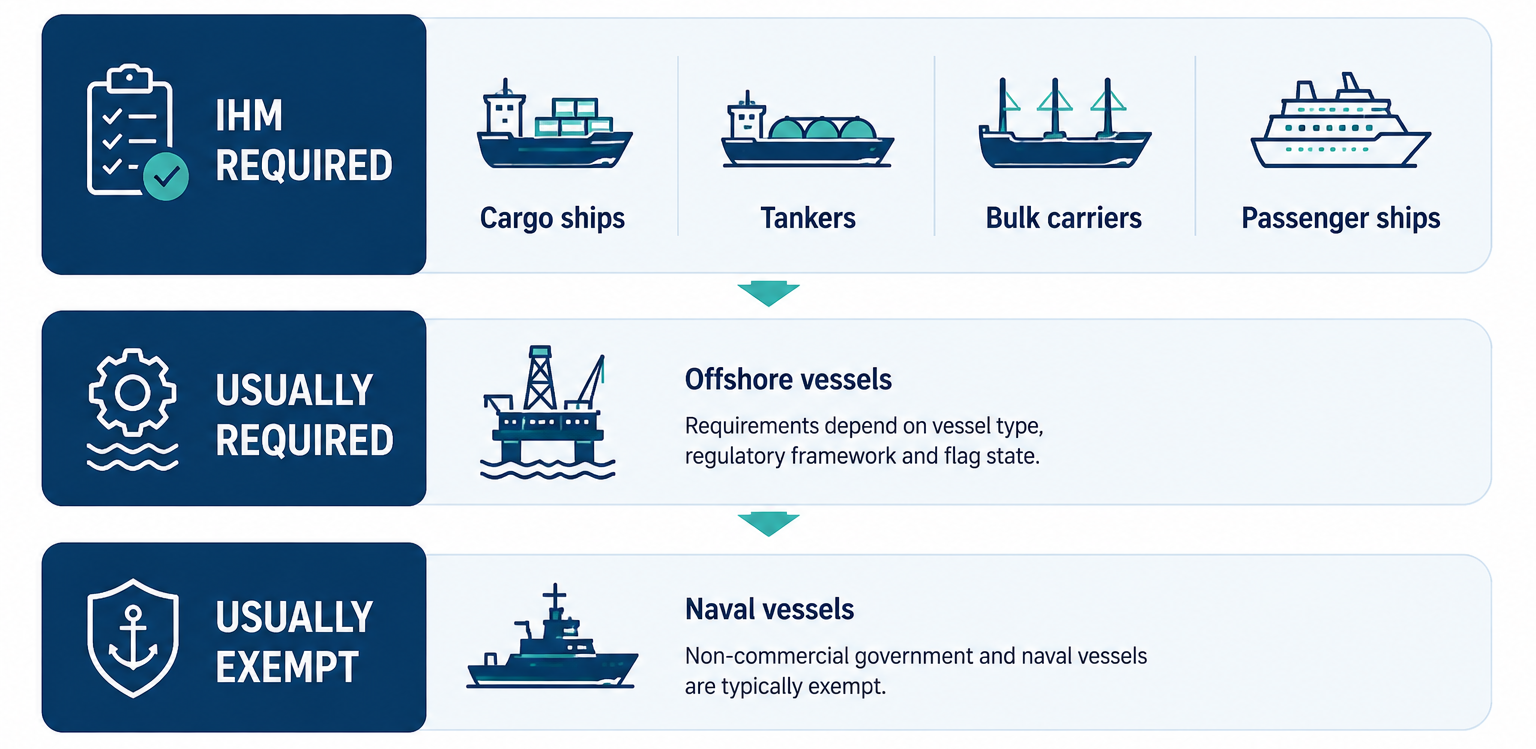
Fig. 1: Which Ships Require an IHM?
Coming Next: Understanding the Three Parts of an IHM
Preparing an Inventory of Hazardous Materials involves much more than listing hazardous substances. The IHM is divided into three distinct parts, each serving a different purpose throughout a vessel’s lifecycle.
In the next release, we discuss:
- The three parts of an IHM
- Common hazardous materials found onboard
- How an IHM survey is conducted
- How the inventory is verified and certified
By understanding how the IHM is prepared, shipowners can better appreciate why accuracy is critical for regulatory compliance, worker safety, and efficient vessel management.